A single data center building is a logistics challenge. A multi-phase campus is a logistics system, and systems fail differently than buildings do. As hyperscalers and colocation providers move from […]
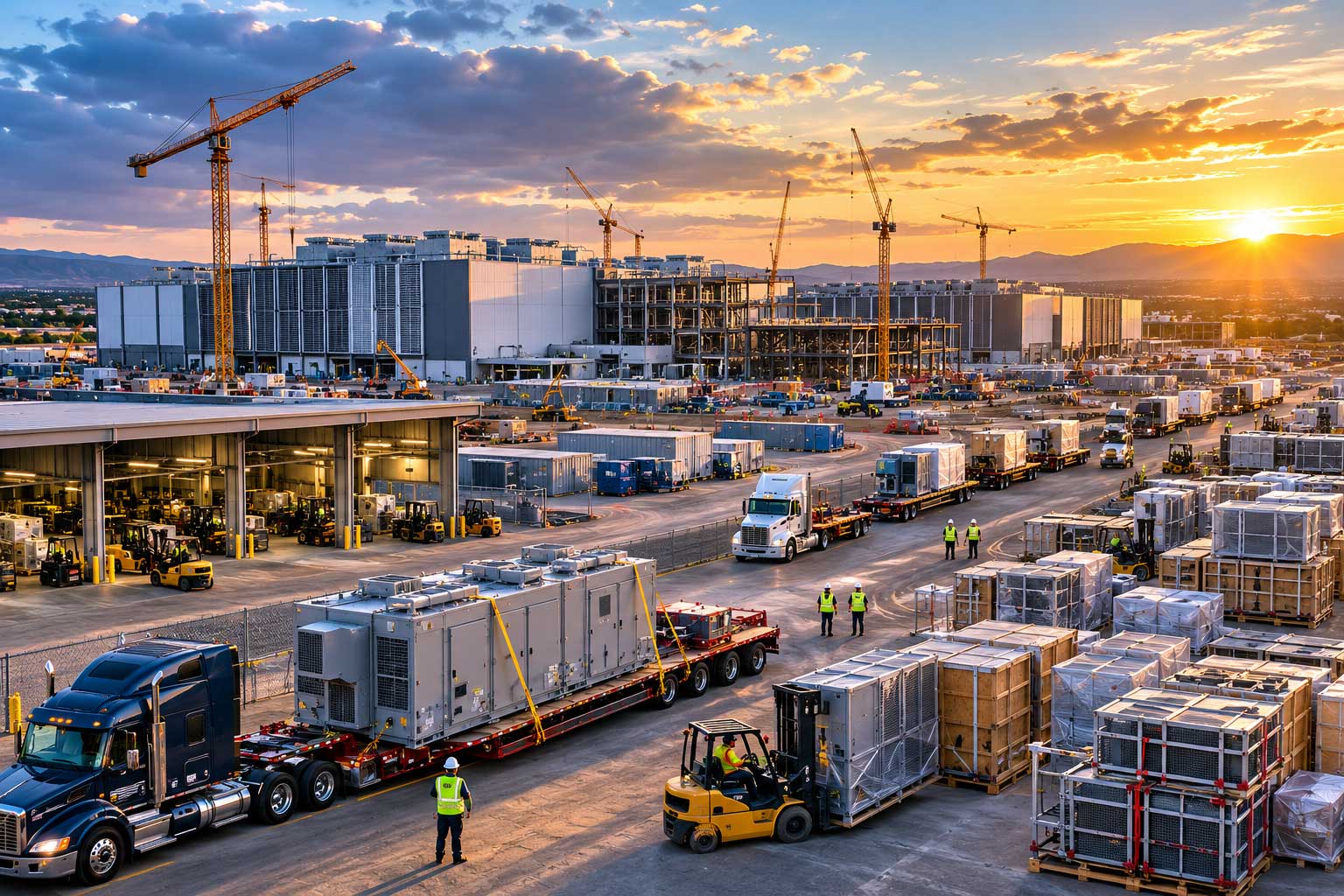
A single data center building is a logistics challenge. A multi-phase campus is a logistics system, and systems fail differently than buildings do.
As hyperscalers and colocation providers move from single-site deployments to sprawling, multi-building campuses delivered in overlapping phases, the logistics model that worked for Phase 1 quietly stops working by Phase 3. The problem is rarely equipment or labor. It is coordination at scale, and most programs do not discover the gap until schedules start slipping.
When a campus grows from one building to four, five, or more, delivered in staggered phases with different general contractors, OEMs, and commissioning timelines, the logistics burden does not grow proportionally. It compounds.
Overlapping schedules create competing priorities. Phase 2 startup activities, Phase 3 rough-in, and Phase 4 site prep can all be happening simultaneously across the same campus. Equipment destined for one building can end up competing for laydown space, crane time, or dock access with equipment for another.
Storage becomes a bottleneck instead of a buffer. On a single-building project, a contractor can often store critical equipment onsite or nearby without much friction. Across a multi-phase campus, the volume of switchgear, generators, CRAH units, and electrical infrastructure arriving on different timelines quickly overwhelms available laydown space. Without a dedicated, sequenced storage strategy, equipment sits in the wrong place at the wrong time, or worse, gets damaged waiting for its installation window.
Visibility fragments across stakeholders. Owners, GCs, OEMs, and commissioning teams each have their own view of what is arriving, what is staged, and what is ready. On a multi-phase campus, those views rarely match. A piece of equipment marked “delivered” in one system may still be sitting on a truck, or staged in the wrong yard, because no single source of truth exists across the program.
Accountability gets diluted. When multiple transportation providers, multiple storage vendors, and multiple site logistics teams are each responsible for a slice of the supply chain, a delay in one lane becomes everyone’s problem and no one’s fault. Schedule risk increases exactly when the program needs the opposite.
Rework and re-handling costs compound. Equipment staged without a clear installation sequence often gets moved two or three times before it reaches its final position. Each touch adds cost, risk of damage, and time that was never in the schedule to begin with.
None of these problems are visible on day one. They emerge as the campus scales, which is exactly when they are hardest and most expensive to fix.
The fix is not more trucks or more warehouse space. It is a shift in how logistics is structured: from a set of independent vendor relationships to a single, integrated program built for the scale of a multi-phase campus.
This is the model Stream Mission Critical operates as the Logistics General Contractor for AI data centers, and it is built specifically to close the gaps that appear as campuses grow.
Stream Hyperscale Warehousing™ replace ad hoc laydown space with a dedicated project operations hub. Rather than treating storage as overflow space, Stream Hyperscale Warehousing function as a purpose-built extension of the jobsite, with receiving, handling, quality control, inventory management, and L2 commissioning stations under one roof. Equipment for every phase has a defined home before it ever leaves the OEM.
Installation-Sequenced Delivery eliminates the guesswork of what arrives when. Instead of equipment showing up on the OEM’s timeline and waiting for the site to catch up, deliveries are sequenced to match the actual installation plan for each phase. Equipment shows up ready to install, not ready to store.
Dedicated Hyperscale Transport and Field Lift Pro reduce the number of times equipment is touched. Field Lift Pro’s crane-free handling approach, paired with dedicated transportation built around hyperscale-scale equipment, cuts down the re-handling that typically happens when heavy or sensitive equipment moves through multiple staging points before installation.
A Digital Chain of Custody gives every stakeholder the same picture. From the moment equipment leaves the OEM to the moment it is installed, its location, condition, and status are tracked in one system. Owners, GCs, and commissioning teams are no longer reconciling conflicting spreadsheets to answer a simple question: where is it right now.
A Single Point of Accountability closes the gap between phases. Instead of managing separate vendors for transportation, storage, and site logistics across each phase of the campus, one program and one dedicated PM team owns the outcome end to end. When something needs to move faster, there is one team to call, not five.
The value of this model grows with the size of the campus. On a single building, good logistics is a convenience. Across a multi-phase, multi-building program with overlapping schedules and multiple stakeholders, it is the difference between a campus that comes online on schedule and one that quietly loses weeks to equipment sitting in the wrong place.
Stream Mission Critical built Stream Hyperscale Warehousing, Dedicated Hyperscale Transport, Field Lift Pro, Installation-Sequenced Delivery, and the Digital Chain of Custody specifically to give owners, GCs, and OEMs back the visibility, control, and capability that gets lost as campuses scale, without adding more work to their plate. We do the sit-ups, and you get the six-pack.
If your program is scaling from a single building to a multi-phase campus, the logistics model that got you through Phase 1 is not built to survive Phase 3. Stream Mission Critical will map your equipment flow, storage needs, and delivery sequencing across every phase, so your team has one point of accountability instead of five vendors to chase.
Recommend adding an FAQ block (visible on-page + FAQPage schema) with these Q&As, since they map directly to how hyperscaler and GC audiences phrase searches and AI assistant queries:
Logistics complexity compounds rather than scales linearly because overlapping schedules, competing laydown space, and fragmented visibility across stakeholders all increase at once as more buildings and phases run in parallel.
A Logistics General Contractor manages OEM transportation, storage operations, and jobsite deliveries as one integrated program under a single point of accountability, rather than coordinating separate vendors for each function.
Stream Hyperscale Warehousing is Stream Mission Critical’s dedicated project operations hub for receiving, handling, quality control, inventory management, and L2 commissioning of data center equipment before installation.
It times equipment delivery to match the actual installation plan for each phase, so equipment arrives ready to install instead of arriving early and needing to be stored and re-handled.
|
Share this Article



|