Transformers that once qualified as routine oversize loads now regularly cross into superload territory. Switchgear, chillers, generators, and modular skids are getting bigger, heavier, and harder to move, at the […]
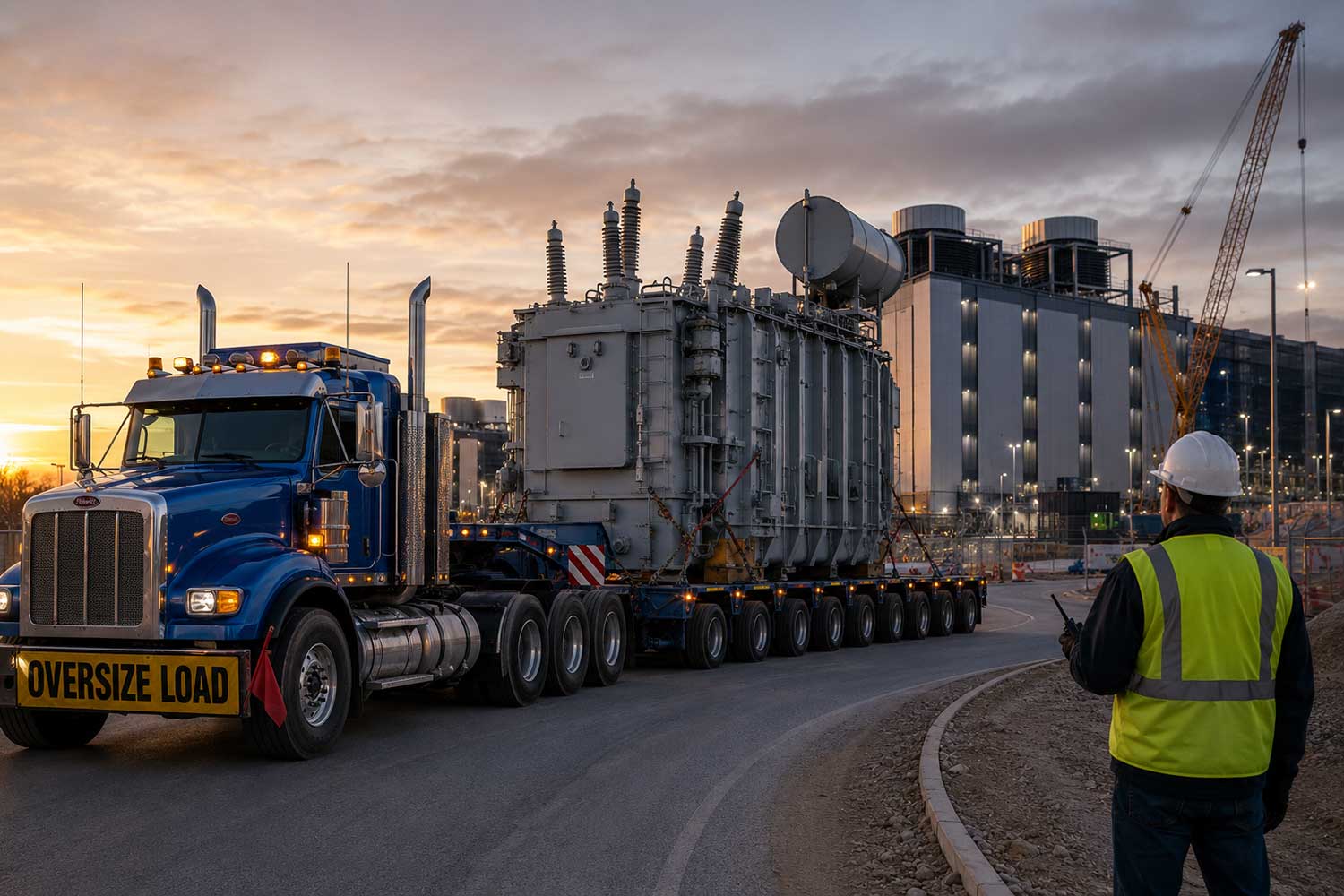
Transformers that once qualified as routine oversize loads now regularly cross into superload territory. Switchgear, chillers, generators, and modular skids are getting bigger, heavier, and harder to move, at the exact moment hyperscale construction is accelerating across the country. For logistics teams supporting AI data center builds, the permit desk has quietly become one of the biggest schedule risks on the project.
2026 has brought real change to how states issue, review, and enforce oversize and overweight (OS/OW) permits. Some of it helps. Some of it adds friction. Almost all of it demands a logistics team that treats permitting as a discipline, not paperwork.
Data center demand has pushed equipment dimensions past what most state DOT systems were built to process quickly. Large power transformers, containerized substations, and battery energy storage units routinely exceed the thresholds that trigger a full engineering route study rather than a same-day approval. In states like Texas, a load over 254,300 pounds gross vehicle weight, or beyond 20 feet wide or 18 feet tall, now enters superload review, which typically means a four to eight week processing window, a pavement and bridge structural analysis, and coordination across multiple counties and municipalities before a single wheel turns.
Multiply that by a construction schedule where the mechanical and electrical equipment fleet arrives in overlapping waves, and permitting stops being an administrative task. It becomes a critical path item that has to be planned months, not weeks, ahead.
At the same time, federal initiatives aimed at fast-tracking large-scale infrastructure projects are pushing some states to build accelerated permitting tiers for qualifying sites. The result is a landscape moving in two directions at once: faster approval pathways for straightforward moves, and deeper scrutiny for the heavy, non-divisible loads that define hyperscale delivery.
For years, OS/OW permitting was a patchwork of phone calls, faxed route maps, and state-specific portals with wildly different interfaces. That is changing faster in 2026 than in the previous decade combined.
Texas’s ePERMITTING system now offers automated route pre-clearance against the statewide bridge database, with instant approval available for loads that fall within pre-approved parameters. Illinois has moved standard applications onto its Transportation Automated Permit system. North Carolina overhauled its payment processing on PIMS. Minnesota is actively soliciting carrier feedback to redesign its own permitting workflow. None of these systems talk to each other, but each one individually is becoming faster and more predictable for carriers who understand how to use it.
Third-party platforms are closing the gap between states. Multi-jurisdictional permitting software now runs real-time route validation, checks vehicle configurations against the Federal Bridge Formula before a permit is even filed, and flags restricted routes directly inside the ELD. Fleet telematics providers have built compliance modules that alert drivers approaching bridge postings or curfew windows in real time, turning what used to be a static paper permit into a live routing constraint the driver cannot miss.
For data center logistics teams, this shift matters less as a technology upgrade and more as a competitive filter. Carriers and logistics partners who have adopted these tools are catching routing conflicts before a truck leaves the yard. Teams still working off static PDFs and phone calls are finding out about a bridge weight restriction after the load is already rolling.
The equipment moving to hyperscale sites today, generators, large power transformers, prefabricated electrical rooms, HVAC skids, is pushing more shipments into superload classification than logistics teams may be planning for. That reclassification changes everything about the timeline: engineering route studies, structural analysis on every bridge along the corridor, coordination with local jurisdictions that state permits do not automatically cover, and fees that can run into the thousands of dollars per move.
A state OS/OW permit authorizes travel on state-maintained roads. It does not automatically clear a load for county roads, city streets, or the final quarter mile onto a jobsite, which is often where the tightest turns and lowest overhead clearances live. Teams that treat the state permit as the finish line are the ones who find out about a local restriction with a loaded trailer already staged.
Generator-heavy data center programs are also running into a second layer of scrutiny that did not exist a few years ago. Updated federal guidance on generator emissions is shaping equipment selection and construction sequencing on projects moving into 2026 permitting cycles, which means the equipment list, and the transport plan built around it, can shift later in the process than logistics teams are used to. A generator swap driven by an air permit condition can mean a different rigging plan, a different route, and a different OS/OW filing on short notice.
This is the piece that catches teams off guard. Permitting is no longer purely a transportation function. It sits downstream of siting, environmental, and equipment procurement decisions that logistics has to track in real time to avoid filing a permit for a load configuration that changes before the truck arrives.
A few practical shifts separate the programs that stay on schedule from the ones absorbing delay claims:
Build permit lead time into the master schedule, not the transport schedule. A superload with a multi-county route can require eight weeks of processing before mobilization. That window needs to be visible to the general contractor’s schedule, not just the logistics team’s internal tracker.
Confirm local authority separately from state authority. A state permit is necessary but not sufficient. County and municipal sign-off, especially for the final approach to the jobsite, has to be verified as its own line item.
Track equipment specification changes against open permit filings. When a transformer, generator, or switchgear package changes late in procurement, whether for emissions compliance, lead time, or supply availability, the permit filed against the old configuration is no longer valid.
Treat digital permitting adoption as a carrier qualification criterion. Partners running real-time bridge formula checks and live route validation are catching problems before mobilization. Partners still working off static documents are finding them after.
Centralize accountability. Multi-state, multi-agency, multi-load programs create too many handoff points for permitting to live with any single vendor in isolation. The programs that stay on schedule are the ones where one team owns the full chain, from OEM release to jobsite delivery, and carries permitting as part of that single point of accountability rather than a separate transactional task.
| State | System | What Changed for 2026 |
|---|---|---|
| Texas | TxPROS / ePERMITTING | Automated route pre-clearance against the statewide bridge database; instant approval for standard loads within pre-approved parameters; superload threshold at 254,300 lbs GVW or 20′ wide / 18′ tall |
| Illinois | ITAP (Illinois Transportation Automated Permit) | Standard applications fully online; local jurisdiction sign-off still required separately for non-IDOT roads |
| North Carolina | PIMS | New credit card processor as of June 2026; registered-card workflow changing for renewal and repeat filers |
| Minnesota | MnDOT OSOW portal | Active carrier feedback survey underway to redesign the permitting workflow |
| Multi-state | Bentley SUPERLOAD and similar platforms | Real-time route validation and live bridge analysis now standard for carriers managing multi-jurisdictional superloads |
This is not a complete state-by-state guide, and permit rules change on their own timeline in every jurisdiction. Treat it as a starting point for where to focus diligence, not a substitute for confirming current requirements directly with each state DOT before a move.
The permit desk was never designed to move at the pace hyperscale construction now demands. States are modernizing, but unevenly, and the loads getting shipped to data center sites are getting larger faster than most permitting systems anticipated. For logistics teams, the programs that stay on schedule in 2026 will be the ones that plan for superload lead times from day one, verify authority at every jurisdictional layer, and keep transport planning connected to the equipment and environmental decisions happening upstream.
That is the operational discipline behind Stream Mission Critical’s approach to every move, permit, and delivery window on a hyperscale program.
|
Share this Article



|