Every phase on your campus can be individually on track and the overall schedule can still be slipping. If that sounds familiar, you’re not dealing with a vendor performance problem. […]
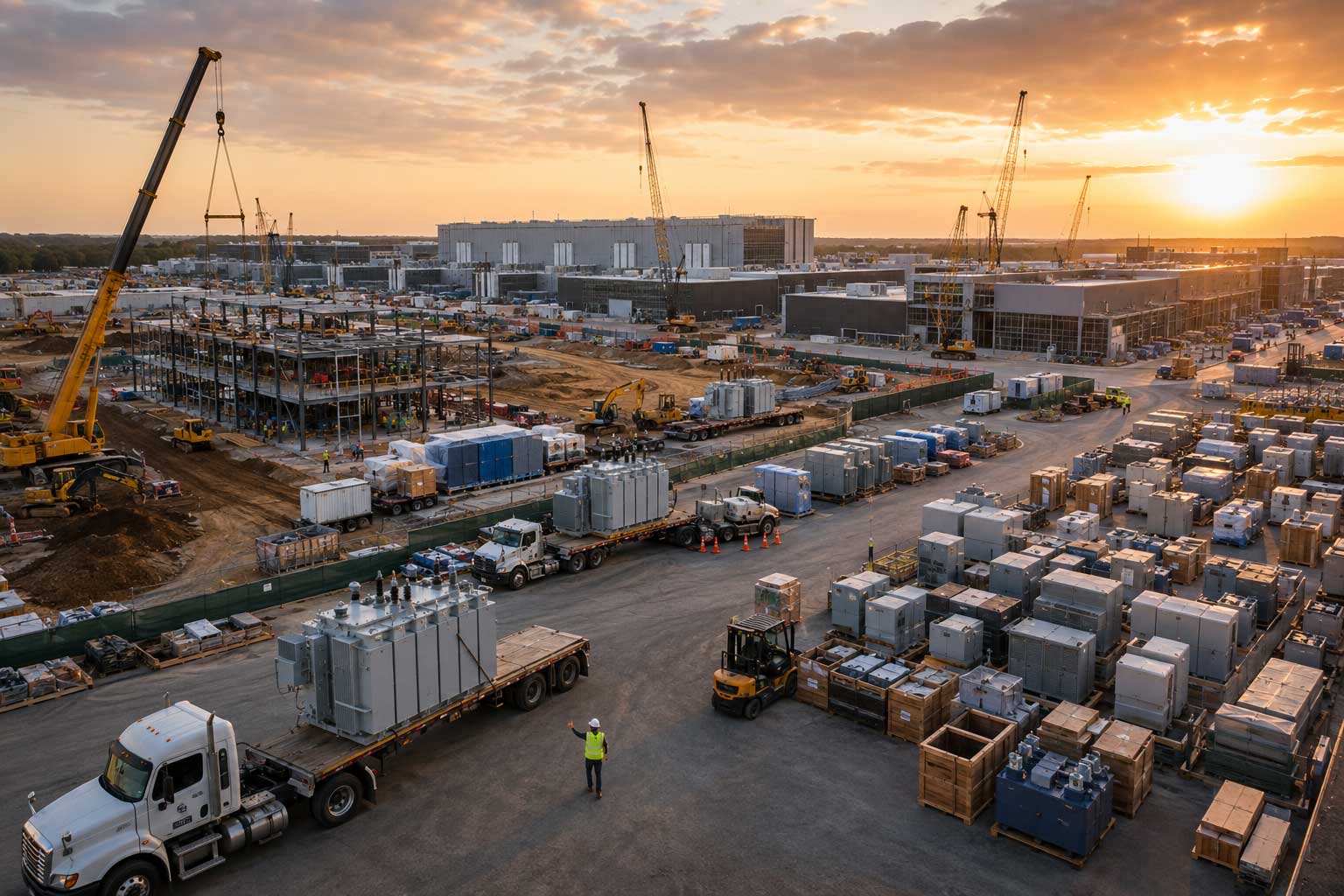
Every phase on your campus can be individually on track and the overall schedule can still be slipping. If that sounds familiar, you’re not dealing with a vendor performance problem. You’re dealing with a sequencing problem, and it’s one most logistics plans aren’t built to catch until it’s already cost you a week.
This is the question worth asking before the next phase breaks ground: what actually happens when four or five phases are drawing on the same yard, the same crane windows, and the same delivery corridors at once, and who is watching the interaction between them?
Single-building logistics is linear. Equipment arrives, stages, installs, and gets commissioned in a sequence that’s easy enough to track by hand.
A multi-phase campus has no such linearity. Phases overlap. Site conditions change week to week as earthwork finishes in one zone while switchgear installs in another. Equipment procured for Phase 4 may sit in inventory for months while Phase 2 finishes, and where it sits, how it’s tracked, and when it moves determines whether Phase 4 starts on time or slips behind it.
If your team is already seeing any of the following, the plan you’re running was built for a different scale of problem:
None of these show up in a single-project schedule. All of them show up fast at campus scale.
Most logistics plans treat storage as a holding pattern; equipment arrives early, sits until needed, and the yard is just a fenced lot. At campus scale, that assumption gets expensive. When equipment for four or five phases is staged simultaneously, storage becomes an active part of the schedule. Without a deliberate strategy, campuses end up with double-handling, equipment buried behind gear needed sooner, and no clear record of custody when something goes missing or gets damaged in a yard no one is actively managing.
The fix isn’t more storage space. It’s a yard strategy designed around the installation sequence itself: what needs to be accessible first, what can sit deeper in inventory, and how equipment moves out in the exact order the field needs it. Paired with delivery that’s sequenced to the schedule rather than the shipment date, this alone eliminates most of the re-staging that quietly eats weeks on large campuses.
Here’s the piece most logistics plans overlook entirely: commissioning and storage are treated as two separate phases, disconnected in time and in responsibility. Equipment sits in the yard, eventually moves to the field, and only then does testing begin. If a defect surfaces at that point, it’s discovered after the crane has already lifted it and the crew is already staged.
There’s a better answer, and it’s rarely used because it requires storage and commissioning to sit under the same team: L2-level commissioning performed directly at the warehouse, while equipment is still in storage. Switchgear, skids, and major electrical assemblies get functional-level testing and verification before they ever leave the yard. Factory damage, wiring errors, and component defects get caught while the equipment is sitting still, not after it’s been lifted into place on a live site.
On a multi-phase campus this matters more than it does on a single project, because the cost of a late-discovered defect compounds. A failure caught in the field on Phase 3 doesn’t just delay Phase 3; it holds a crane and a crew that Phase 4 is counting on. Catching that same defect in the warehouse costs a few hours on a test station. It never touches the field schedule at all.
Campus builds bring more transformers, generators, and switchgear moving through the same footprint at once, often across zones still under active construction. Crane availability becomes a shared, scarce resource across every phase running concurrently, and a single crane conflict can back up multiple workstreams simultaneously.
Removing the crane dependency for qualified equipment moves frees up lift capacity in one zone so another phase can keep moving, instead of every phase queuing behind the same piece of heavy equipment.
The other gap that shows up almost exclusively at the data center campus scale is accountability. On a single project, it’s usually clear who owns a delivery problem. Across six or eight phases, with different subcontractors and different procurement timelines, responsibility gets diffuse fast. When something goes wrong, the first conversation is often about who’s responsible, not how to fix it.
That’s solved with one team owning logistics performance across every phase of the campus, backed by a verifiable record of every asset from yard to field to installed equipment. When you’re running a dozen workstreams at once, that single point of ownership is what keeps a miss in one phase from becoming an unresolved argument that stalls three others.
If you’re planning a multi-phase campus and can’t yet answer who owns logistics across every phase, how storage is sequenced to the schedule, or whether equipment is tested before or after it reaches the field, those are the three gaps worth closing first, before the next phase breaks ground.
Stream Mission Critical works with hyperscaler teams at exactly this stage of planning, mapping campus logistics and commissioning sequencing before mobilization starts. If you want a second set of eyes on your current campus plan, reach out to our team for a working session on your sequencing, storage, and commissioning strategy.
Construction builds it. Commissioning proves it. Operations sustain it. Innovation transforms it.
|
Share this Article



|